A fresh “XRP supply shock” narrative has been making the rounds on X, with several large accounts circulating a Glassnode chart of exchange balances and arguing ETFs are rapidly draining liquid supply. An XRP Ledger dUNL validator, however, rejected the premise outright, saying the numbers and the market structure don’t support a true allocation squeeze.
One widely shared post came from @unknowDLT, who wrote on Dec. 27: “XRP ETFs are absorbing supply fast. With only ~1.5B XRP left on exchanges and ~750M absorbed in weeks, a supply shock is likely by early 2026.” The account tied that thesis to the “Clarity Act,” arguing it would “forc[e] price discovery” and position 2026 as the moment XRP shifts “from speculation to global liquidity infrastructure.”
Is A XRP Supply Shock Really Coming?
Vet (@Vet_X0), an XRP Ledger dUNL validator, responded on Dec. 28 with a screenshot indicating exchange balances closer to 16 billion XRP, not 1.5 billion, and framed the supply-shock talk as a static misread of a dynamic market.
“There is no XRP supply shock on exchanges,” Vet wrote. “1) Holders have close to 16B XRP on exchanges readily available. Plenty for anyone to get some. 2) If the price goes up or down anyone of you who has no XRP on exchanges could just send theirs within 3-4 secs to one.”
Vet’s broader point was that exchange balances and order-book liquidity are not fixed quantities; they change rapidly with price and incentives. In his view, that makes “supply shock” a much higher bar than a chart implying balances are trending down.
“Thus, also XRP listed on orderbooks for sale is dynamic. Elastic, it can thicken or dry out in seconds back and forth,” he wrote. “Sometimes $10M buying can push price higher and sometimes $100M buying doesn’t stop price going down regardless. Markets are too dynamic to statically plot movements.”
The debate then moved to confidence in the wallet labeling and the underlying counts. Popular pundit Zach Rector (@ZachRector7) questioned whether some entries looked “off,” citing one example: “Evernorth only has 86 million XRP?” Vet replied that the published list should be treated as conservative, not exhaustive.
“Full confidence that these numbers are the lower bound of what actually is on exchanges,” Vet wrote. “Means, these numbers are at worst on the lower end and that there are more accounts of exchanges we haven’t seen yet. I mean just check Upbit alone, lets only look at 4 out of many xrp accounts they have. 2B XRP. This is only a portion of Upbit, not even counting other exchanges.”
Others argued that even if balances are large, effective float could still tighten due to custody structure, escrow cadence, and institutional accumulation. Dman Trader (@dmantrader) pointed to monthly escrow mechanics and claimed ETF holdings sit in dedicated XRPL wallets, describing them as “Locked up 1% of total supply already in a couple months,” while also arguing that CEX and OTC inventories earmarked for clients are hard to measure.
Vet acknowledged a logistical angle — “Ripple is noting in the XRP report they facilitate supply transfers for ETFs” — but maintained that a genuine supply shock implies an immediate allocation imbalance, not simply steady accumulation.
“A supply shock implies allocation imbalance by the market. Which is not true,” Vet wrote. “Sure, if tomorrow someone says I want 30B XRP now then there will be a supply shock. But this person aside, with 16B and many more billion in Ripple hot accounts it’s very fair to say we have enough for everyone to get their hands on XRP.”
For now, the thread draws a clear fault line: influencer-driven balance charts framing scarcity versus an infrastructure-side argument that XRP liquidity is elastic, rapidly mobilized, and unlikely to “shock” without an unusually large, urgent bid.
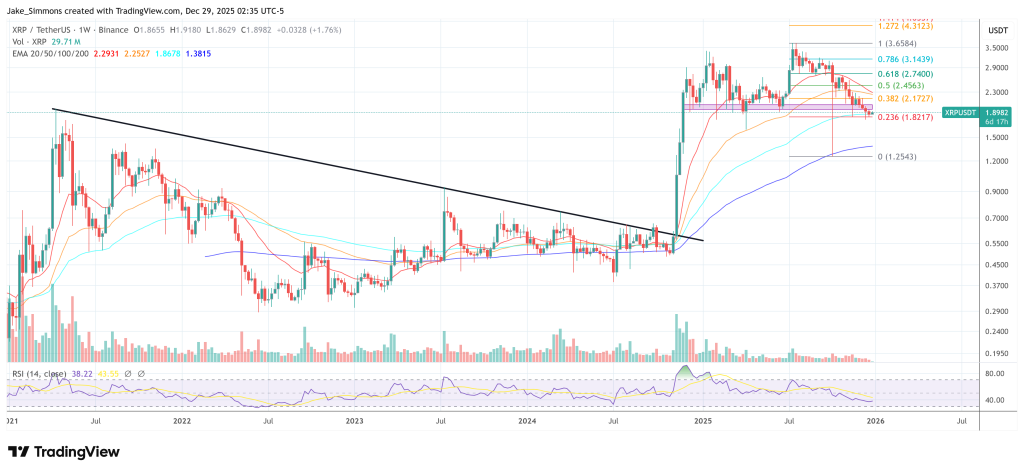
At press time, XRP traded at $1.8982.