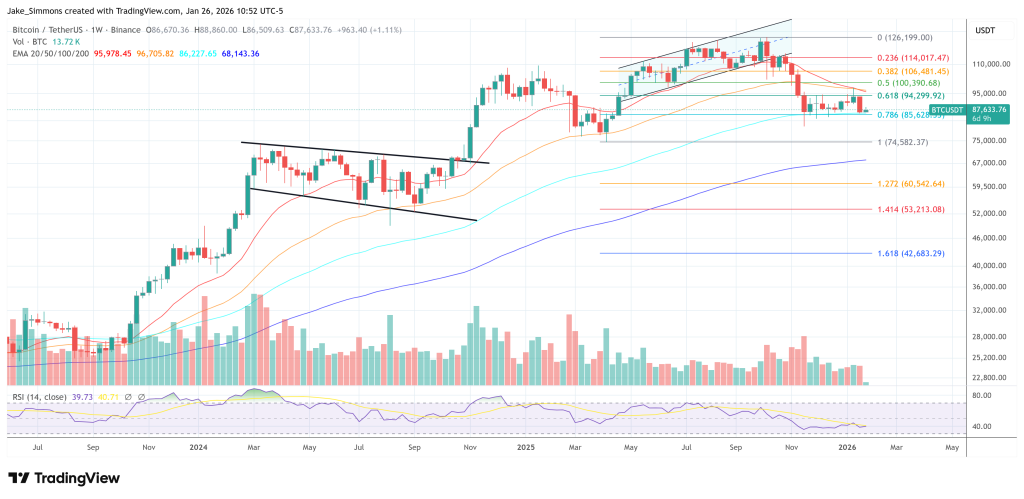
BlackRock has filed an S-1 for an “iShares Bitcoin Premium Income ETF,” a product that aims to track bitcoin’s price while generating option premium by systematically selling calls tied primarily to its own spot bitcoin ETF, IBIT. For BTC-linked derivatives markets, the filing is being read less as a directional catalyst and more as another potential source of mechanical volatility supply.
Bloomberg ETF analyst Eric Balchunas flagged the document on X, noting that key commercial details are still missing. “BlackRock just dropped the official S-1 for it’s upcoming iShares Bitcoin Premium Income ETF.. no fee or ticker yet,” Balchunas wrote. “The strategy is to ‘track performance of the price of bitcoin while providing premium income through an actively managed strategy of writing (selling) call options primarily on IBIT shares and, from time to time, on ETP Indices.’”
BlackRock just dropped the official S-1 for it’s upcoming iShares Bitcoin Premium Income ETF.. no fee or ticker yet. The strategy is to “track performance of the price of bitcoin while providing premium income through an actively managed strategy of writing (selling) call options… pic.twitter.com/CZDahm4mNj
— Eric Balchunas (@EricBalchunas) January 26, 2026
Here’s What It Could Mean For Bitcoin
The basic premise is familiar to anyone who has watched covered-call equity ETFs: sell upside to monetize implied volatility. In bitcoin’s case, the underlying options are written on an ETF wrapper rather than directly on BTC, but the economic effect is similar, steady call overwriting can increase supply of short-dated upside exposure and compress the premiums available to sellers over time, particularly if multiple products pursue comparable programs.
That dynamic was the focus of commentary from Wintermute’s head of OTC trading, Jake Ostrovskis, who framed the filing as additive to an already crowded volatility-selling landscape. “BTC vols already suffer from significant oversupply following the rollout of ETFs, SP’s & options on IBIT,” Ostrovskis posted. “Now add more mechanical vol selling and the only logical outcome is further steady decline in yield from market-implied premiums.”
The implication is not that bitcoin’s price must fall because a premium-income ETF exists, but that the “income” component could become harder to sustain at attractive levels if implied volatility continues to be leaned on by systematic call sellers. In that world, headline yields may drift lower, and the payoff profile becomes increasingly path-dependent, premium capture in quiet regimes can look reliable, but it can also leave investors structurally underexposed to sharp upside moves if BTC trends higher through the strikes being sold.
For market participants trying to extract option premia from BTC exposure, Ostrovskis argued the edge shifts away from simply being short vol and toward execution and distribution. “Structuring/timing + leaning on axes via OTC desks will become increasingly important to optimise returns on otherwise dormant assets,” he wrote, pointing to the growing role of bespoke structuring, strike selection, tenor management, and liquidity access as the trade becomes more crowded.
If BlackRock proceeds and demand materializes, the next question for traders will be how much incremental call supply the strategy represents relative to existing IBIT options activity and whether that supply concentrates in specific expiries or strikes. Either way, the filing underscores a broader maturation trend: as BTC exposure becomes more ETF-native, the center of gravity for volatility pricing may continue to migrate toward the wrapper’s options market, with implied premiums increasingly shaped by systematic flows rather than discretionary views.
At press time, Bitcoin traded at $87,633.