Crypto analyst Matt Hughes is arguing the global liquidity cycle is stretching well beyond its usual rhythm and that the extension is precisely why staying structurally bearish on crypto has been so punishing since 2020. Hughes, who posts as “The Great Mattsby,” said Monday that the cycle is “now ~6 years strong post-2020 with no clear peak in sight as of early 2026,” framing the move as something closer to a super-cycle than a standard 4–6 year expansion.
What This Means For The Crypto Market
Hughes’ core claim is that the traditional mechanism that ends liquidity cycles, central banks tightening into contraction, is being blunted by a mix of debt math, fragmented global money creation, and a capital-intensive investment boom that keeps pulling liquidity back into risk assets rather than allowing it to drain out.
“The current global liquidity cycle is on track to become the longest ever, smashing past the typical 4–6 year patterns we’ve seen historically. Here’s why it’s stretching into a true super-cycle (now ~6 years strong post-2020 with no clear peak in sight as of early 2026):” Hughes wrote, before laying out the macro pillars of the thesis.
First, Hughes points to the scale of leverage in the system as a constraint on normalization. “Global debt/GDP >350% creates a refinancing nightmare,” he wrote, arguing that each policy response has to be larger to prevent defaults and that aggressive tightening risks cascading sovereign and emerging-market stress. In that framework, policy makers are boxed into “perpetual support mode,” which delays the kind of contraction that would normally mark the end of a liquidity upswing.
Second, Hughes argues the cycle can run longer because global liquidity is no longer dominated by a single central bank. “The old dollar-only world is fragmenting,” he wrote, describing a “bifurcation of the global monetary system” in which liquidity creation outside the US can offset periods when the Federal Reserve is tighter. In his telling, a multipolar setup — spanning “BRICS nations,” China as a major credit creator, and alternative stores of value including “yuan, gold, crypto” — makes the overall system more resilient than past cycles that were more synchronized.
Third, Hughes links the endurance of the cycle to an unusually large wave of capital demand. He calls AI, renewables, data centers, chip fabs, and blockchain “capital hogs,” arguing that the scale of funding required “demand & absorb endless liquidity.” He also ties that directly to market behavior, writing that risk assets like “IWM small-caps, ARKK innovation, BTC” pushing toward or near all-time highs is consistent with a cycle that is “closer to start than end.”
Finally, Hughes emphasizes a policy bias toward preventing downturns. He described central banks as “hyper-proactive,” citing tools like forward guidance and yield curve control alongside tighter fiscal-monetary coordination. He also argued geopolitical priorities: reshoring, infrastructure, and the energy transition reinforce a stimulus-leaning posture, while traditional recession signals have been less reliable, pointing to a record-long 10y/3m inversion “without collapse.”
Not everyone in the thread accepted the implication that the liquidity impulse remains cleanly supportive. A user posting as zam flagged a near-term risk: “My concern here is that Michael Howell says that liquidity momentum is slowing down considerably and that the liquidity is peaking very soon for this cycle. Any thoughts on that?” Hughes’ reply was succinct: “It can rotate into other assets as long as the economy is strong.”
For crypto markets, the exchange captures the key tension: whether the cycle’s length is the dominant story, or whether a decelerating liquidity impulse changes the playbook via rotation rather than outright collapse. Hughes’ framing leaves the timing open-ended, asking followers whether the crypto peak arrives “at the end of 2026 or even longer,” while implicitly suggesting bears may need a clearer, system-wide rollover in liquidity, not just slower momentum, before the macro backdrop decisively turns.
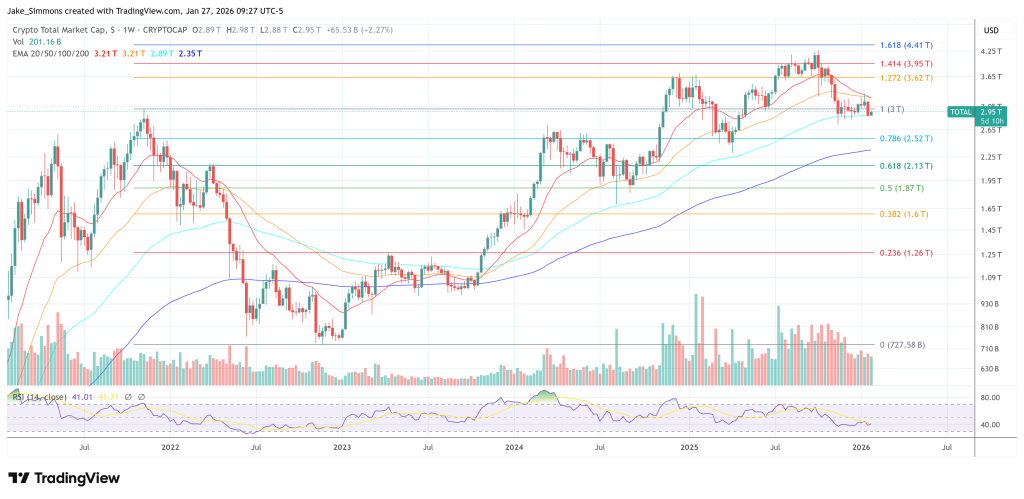
At press time, the total crypto market cap stood at $2.95 trillion.