

OKX has announced the launch of the OKX Card in Europe, expanding its payments footprint across the European Economic Area. The product allows users to pay with stablecoins at merchants that accept Mastercard, positioning crypto balances for direct everyday use rather than requiring prior conversion or preloaded fiat balances.
The announcement comes at a time when crypto infrastructure is increasingly intersecting with traditional financial rails. While price action across major assets remains volatile, platforms are continuing to build payment and settlement tools aimed at reducing friction between on-chain assets and real-world spending.
Rather than introducing a new payment concept, OKX is formalizing an existing demand: using stablecoins as a transactional medium within regulated environments. The broader relevance of the launch lies less in novelty and more in how crypto-native mechanics—such as self-custody and on-chain settlement—are being adapted to conventional consumer payment formats.
Crypto Payments, DeFi, and TradFi Convergence
According to the details released by OKX, the OKX Card enables direct stablecoin payments without requiring users to manually convert assets or preload funds. Stablecoins remain in the user’s wallet until purchase, when conversion occurs at checkout.
The card charges no transaction or FX fees and applies a stated 0.4% market spread when converting stablecoins to euros. It is issued via a licensed European payments partner and operates under standard AML and KYC requirements within the EEA.
The card supports Apple Pay and Google Pay, and functions anywhere the Mastercard network is accepted. OKX also confirmed a limited rewards program, offering crypto-denominated cashback during the initial launch period.
This launch reflects a broader trend: firms are repackaging DeFi infrastructure into TradFi-facing products. These companies now embed core DeFi elements—self-custody, on-chain settlement, and stablecoin liquidity—directly into regulated consumer tools like payment cards.
This does not replace DeFi, but extends its utility beyond native crypto environments. DeFi is no longer only an alternative system running in parallel, but a backend layer increasingly integrated into traditional financial interfaces.
OKB Consolidates After Sharp 2025 Repricing
OKB is trading near $107 on the daily chart, consolidating after a sharp repricing cycle that unfolded in the second half of 2025. The structure reflects a classic post-rally digestion phase rather than active trend continuation. After peaking above the $220–$240 area, the price entered a prolonged corrective move that erased a large portion of the prior advance and shifted market control back toward sellers.
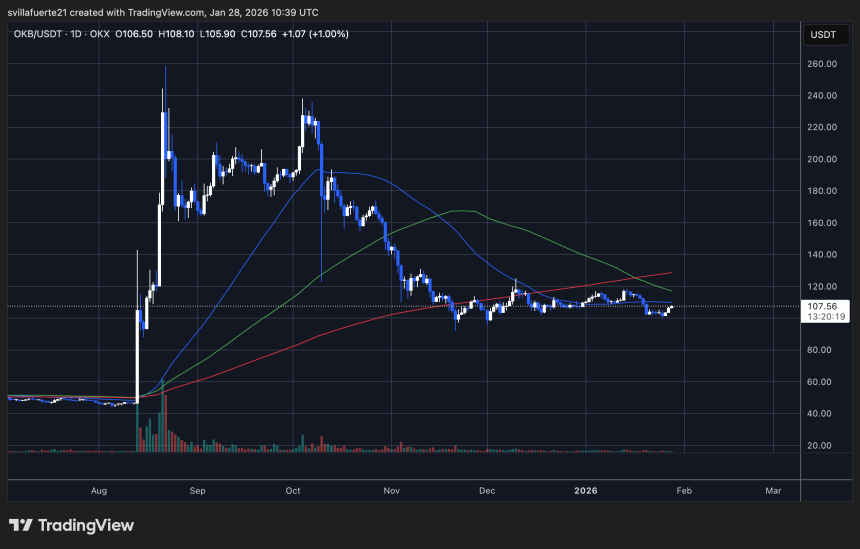
From a trend perspective, the moving averages define the current regime clearly. OKB remains below the 50-day moving average (blue), which has turned down and continues to cap upside attempts. The 100-day moving average (green) is also sloping lower, reinforcing a zone of layered resistance between roughly $120 and $135. In contrast, the 200-day moving average (red) is still rising and currently sits just below price, acting as a key medium-to-long-term support reference.
Recent candles show reduced volatility and compressed ranges. While volume has declined materially compared to the distribution phase near the highs. This combination points to market equilibrium, not aggressive selling pressure. Buyers appear willing to defend the 200-day average, but lack the momentum needed to reclaim short-term trend levels.
Featured image from ChatGPT, chart from TradingView.com
