

XRP is once again under pressure as renewed selling activity and weakening market structure raised fresh concerns about whether the token can maintain support above the critical $1 level.
After briefly attempting a recovery earlier this month, XRP has slipped back into a corrective phase, reflecting broader weakness across digital asset markets and growing caution among traders.
Recent price action shows how quickly sentiment can shift. What appeared to be a potential breakout has instead turned into another test of investor confidence, with technical indicators and macroeconomic trends now shaping the short-term outlook.
Heavy XRP Selling Sparks Fresh Downtrend
The latest decline followed a large wave of selling on South Korean exchange Upbit, where roughly 50 million XRP were offloaded within a 15-hour window. Market data indicates that nearly all of the activity represented genuine spot selling rather than wash trades, suggesting real liquidation from retail or institutional participants.
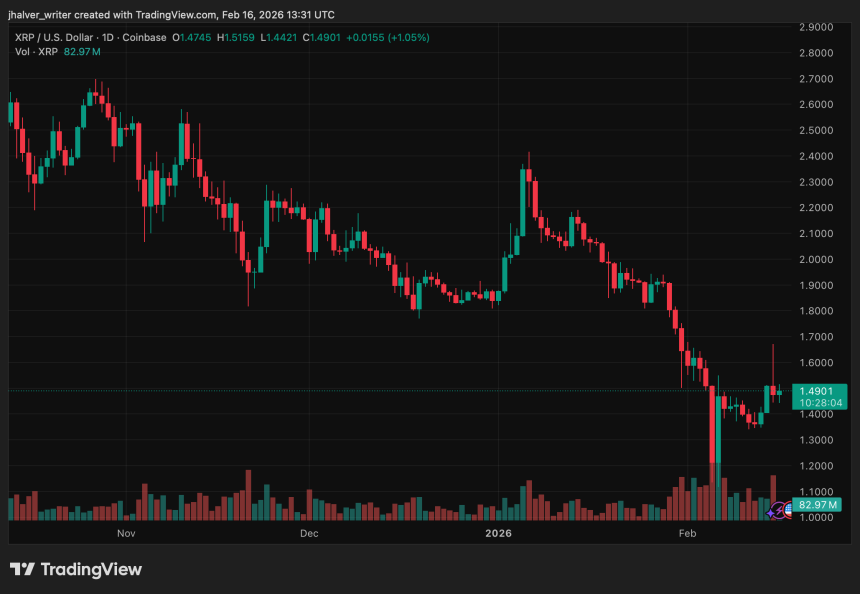
The sell-off pushed XRP toward the $1.44–$1.5 range, marking a two-day low and extending losses across the broader crypto market. The token has dropped about 11% in 24 hours and nearly 30% over the past month despite a brief rebound attempt earlier in February.
Technically, XRP has broken below a multi-month descending trendline, turning former support near $1.51 into resistance. Analysts now view the $1.35–$1.40 zone as a key defense level.
Failure to hold the defense zone could expose downside targets at $1.30 and potentially the February lows near $1.15, with some projections pointing toward $1.00 if selling pressure persists.
Institutional Developments Offer Mixed Signals
While XRP price action remains weak, developments around the ecosystem paint a more complex picture. Trading data shows derivatives activity increasing, with open interest rising and options volume surging, indicating that traders are actively positioning around current volatility.
Meanwhile, comments from SBI Holdings CEO Yoshitaka Kitao clarified that the Japanese financial group holds roughly a 9% stake in Ripple Labs rather than billions of dollars worth of XRP, dispelling speculation circulating online.
Regulatory momentum also drew attention after Ripple CEO Brad Garlinghouse joined a U.S. Commodity Futures Trading Commission advisory committee, a move viewed as a sign of improving industry relations with regulators.
Long-Term Utility vs Short-Term Market Pressure
Beyond market turbulence, activity on the XRP Ledger continues to expand, particularly in tokenized real-world assets such as commodities. Data shows rapid growth in the value of tokenized commodities recorded on the network, positioning it among the leading blockchain platforms in this emerging sector.
However, analysts caution that network adoption does not immediately drive price appreciation. Broader macro factors, including liquidity rotation toward artificial intelligence investments, geopolitical uncertainty, and cautious monetary policy expectations, continue to weigh on crypto assets.
Cover image from ChatGPT, XRPUSD chart on Tradingview
