Dogecoin has a new utility pitch, and this one is aimed squarely at one of crypto’s most discussed institutional themes.
In a X post on February 26, Dogecoin Foundation director Timothy Stebbing said he has spent the last 12 months working toward a plan to make Dogecoin “an asset-backed currency” within two to three years by pushing real-world asset tokenization through a Dogecoin-denominated rules engine called Fractal Engine, with a longer-term goal of eventually moving that activity onto Dogecoin’s base layer through protocol upgrades.
Dogecoin Price May Get Major Utility Boost
Stebbing’s argument is not that Dogecoin should merely host tokenized assets somewhere in its orbit. It is that DOGE itself should become the trading currency for them. “Make Dogecoin an asset-backed currency in the next 2-3 years by shifting the market for Real World Asset tokenisation to Fractal Engine,” he wrote. “Then once proven, work to migrate RWA tokenization from the sidechain to L1 via protocol upgrades. This would see Dogecoin become the premiere platform for asset tokenisation, denominated in Dogecoin.”
Stebbing is effectively sketching a path where demand for DOGE would come not only from speculation or meme-cycle reflexivity, but from its use as the medium of exchange for tokenized assets. He framed the opportunity in deliberately broad terms, arguing that tokenization should cover “real assets, Hotels, Businesses, Minerals, Oil & Gas etc.” and adding, “if you want to trade, you do it with Dogecoin.” The proposed rollout is phased: start on a sidechain, prove the model there, then seek eventual migration to L1.
The plan I’ve been working toward for the last 12 months: Make Dogecoin an asset-backed currency in the next 2-3 years by shifting the market for Real World Asset tokenisation to Fractal Engine, AKA: the bespoke dogecoin-denominated RWA rules engine.
Then once proven, work to…
— Timothy Stebbing (@tjstebbing) February 26, 2026
The broader backdrop for Stebbing’s pitch is that tokenization is no longer being framed as a crypto niche. In his 2025 chairman’s letter, BlackRock CEO Larry Fink argued that “every stock, every bond, every fund—every asset—can be tokenized,” presenting tokenization as a potential redesign of market plumbing rather than a speculative side narrative.
Fink said that if markets move in that direction, transactions that now take days could clear in seconds, while capital currently locked up by settlement frictions could be recycled back into the economy more quickly. He also wrote that tokenized funds could one day become as familiar to investors as ETFs, provided digital identity infrastructure catches up.
BlackRock has echoed that view at the firm level. In its 2026 investment-products outlook, it said tokenization is helping “bridge the gap” between traditional finance and DeFi, and that it expects the trend to continue making investing faster, cheaper and more accessible while more assets move on-chain at scale.
That makes Stebbing’s proposal easier to understand in market terms: the bull case is not simply that Dogecoin gains another narrative, but that it tries to attach itself to a theme one of the world’s largest asset managers already treats as a serious part of finance’s next phase.
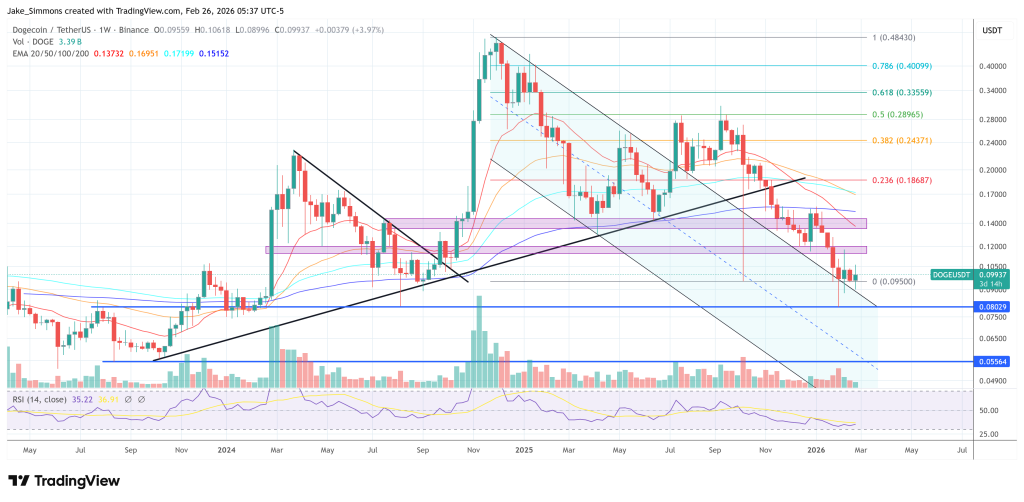
At press time, DOGE traded at $0.09937.