
In an era where computational power is becoming the new petroleum, there emerges an infrastructure capable of making it universally accessible. DGrid represents the inaugural genuinely decentralized AI ecosystem that merges transparency, community ownership, and equitable value distribution.
The Current AI Landscape: Critical Challenges
The Fourth Industrial Revolution, driven by artificial intelligence, confronts fundamental obstacles. Contemporary AI services are characterized by elevated costs, opaque operations, and concentrated control within the hands of a few technology titans. Corporations like OpenAI, Google, and Anthropic have constructed closed ecosystems where:
- Users pay undefined prices for services whose algorithms remain concealed
- User data fuels model training without meaningful profit participation
- Platforms can arbitrarily restrict, censor, or terminate services
Web3 promised a different approach—decentralization, user autonomy, and collective value creation. However, in the artificial intelligence domain, this sector still depends on centralized APIs that undermine its foundational principles.
This reality is now transforming.
DGrid: A New Paradigm in AI Infrastructure
DGrid represents a fundamental reconstruction of AI infrastructure through a decentralized, modular, and completely verifiable network for AI inference. The project’s vision is to transform intelligent computation within the Web3 ecosystem so it becomes minimally trust-dependent, permissionless, and community-driven.
If OpenRouter demonstrated the power of aggregating and routing between AI models, and 1inch showed how optimal path discovery can unlock efficiency in DeFi, then DGrid represents the fusion of both concepts—extended into an autonomous, cryptographically native framework.
DGrid = Web3’s OpenRouter + AI inference’s 1inch + autonomous AI DAO structure
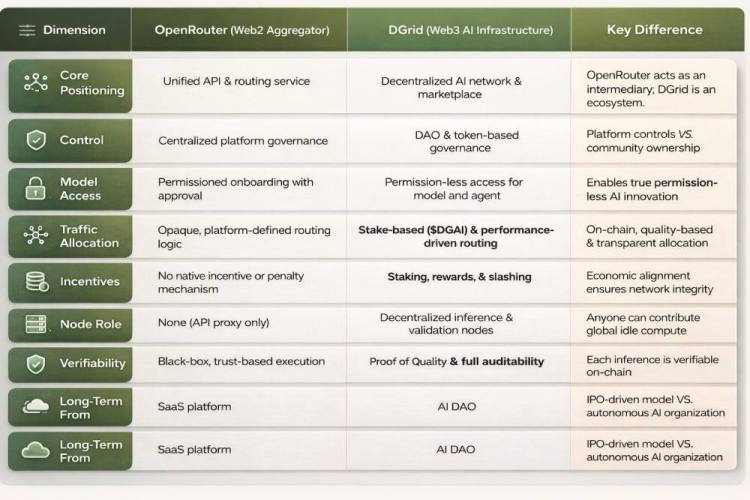 Fundamental Distinctions from OpenRouter: Web3-Native vs. Web2 Optimization
While OpenRouter represents significant progress in AI model aggregation, it remains a Web2 SaaS platform with inherent limitations of centralized systems. DGrid does not aspire to become another OpenRouter—the goal is to transcend the entire model aggregation paradigm through authentic Web3 principles.
The distinction is not incremental—it is structural:
- Economic Architecture: Instead of centralized trust and platform-controlled incentives, DGrid employs a token-based economy and DAO governance. This architecture directly resolves two critical problems: incentive misalignment and trust overhead. All participants—from compute providers to developers—are economically aligned and transparently rewarded, without dependence on a single coordinating authority.
- Performance Capabilities: DGrid is engineered to be fully competitive with centralized aggregators, with a particular advantage in routing and serving niche and emerging models, where decentralized supply can outperform centralized provisioning.
DGrid is not adding another layer to the existing stack—it multiplies its capabilities through cryptographic economic coordination and verifiable infrastructure.
Technological Foundation: The “Trustless Inference” Revolution
DGrid’s confidence rests upon robust academic research and technological breakthroughs. The theoretical framework is derived from advanced scientific work (Ref: https://arxiv.org/abs/2512.16317), developed by a team of PhDs and co-founders—experts in cryptography and AI system architecture.
The DGrid architecture resolves the most formidable challenge in decentralized artificial intelligence: How to guarantee the quality of AI results in an environment of untrusted nodes?
1. Proof of Quality (PoQ): Making Inference Auditable
In a centralized world, users must blindly trust the results returned by OpenAI. In a decentralized network, nodes might return inferior results to reduce costs or even act maliciously.
DGrid introduces the innovative “Proof of Quality” mechanism—a challenge system combining cryptographic verification with game theory. Specialized “Verification Nodes” randomly audit and revalidate inference tasks. If a node’s output fails verification, its staked $DGAI tokens are slashed. This ensures every AI transaction is transparent, traceable, auditable, and fair.
This marks the “trustless” milestone for the AI industry.
2. Modular and Elastic Architecture
- Decentralized Inference Network: No single point of failure and no centralized control. A globally distributed node network collectively maintains system robustness.
- AI RPC Interface: For dApp developers, DGrid integration is as straightforward as connecting to a standard blockchain RPC. A unified gateway enables seamless access to all global LLMs and AI models.
- Node Incentive Economy: Anyone can operate a node, provide computational resources, and earn rewards. This transcends a technical network—it is a computational economy.
3. DGrid’s Operational Process
- Developers submit requests through the standard AI RPC interface (e.g., “Execute this prompt using Llama 3”).
- The DGrid network routes the task to the optimal inference node based on staking and performance metrics.
- The node executes computation, while the Blockchain layer manages verification (PoQ), settlement, and reward distribution.
- Users receive transparent, verified AI results at substantially lower costs.
Backed by Leading Capital and Ecosystem Partners
DGrid has secured robust backing from premier crypto venture capital firms, including Waterdrip Capital, IOTEX, Paramita, Abraca Research, CatherVC, 4EVER Research, and Zenith Capital.
DGrid is more than a protocol—it is rapidly evolving into a comprehensive ecosystem:
- Global Computing Network: Connecting decentralized AI nodes distributed worldwide.
- Extensive Integration: Early integration with leading DeFi, GameFi, SocialFi, and AI Agent protocols to inject “intelligent power” into Web3 applications.
- Strategic Alliances: Established partnerships with Web3 infrastructure giants and top-tier model providers.
Economic Model: DGrid Premium NFT and Token Economics
While DGrid’s technical vision is impressive, its economic model and user rights are equally fascinating. Recognizing that community is the heart of Web3, DGrid has designed a value-return system centered around the DGrid Premium Membership NFT.
Benefit I: Lifetime “All-in-One” AI Membership
Owning a DGrid Premium NFT enables direct access to premium features of all top-tier models on the DGrid.AI platform, covering virtually every major AI product globally. Instead of individual subscriptions to OpenAI (ChatGPT Plus), Google Gemini 3 Pro, or Anthropic Claude Pro, DGrid aggregates these elite models into a single membership at a significant discount: $1,580 USD for the first year, with renewals at only $200 USD annually thereafter.
For intensive AI users, developers, and teams, this represents enormous cost savings and an efficiency leap—the keys to the entire AI arsenal.
Benefit II: Ownership Rights – 50% of Total $DGAI Supply
This is the most aggressive aspect of DGrid’s economic model. Half of the total supply of the platform token, $DGAI, will be distributed exclusively to DGrid Premium NFT holders. This NFT represents “equity” in the future value of the entire DGrid ecosystem. As inference volume grows and more AI Agents operate on the network, the value-capture potential of $DGAI becomes exponential.
These tokens are not merely an airdrop; they serve as permanent credentials for early builders and core supporters of the DGrid network.
Join the Computational Paradigm Shift
Web2 AI giants are attempting to establish a new digital hegemony. They own the data, they control the compute, and they dictate the rules. DGrid is not just a project—it is a movement for AI equality.
Our commitment is to dismantle monopolies, making AI inference a decentralized, accessible, and verifiable public utility—like electricity. With an architecture superior to OpenRouter, a vision comparable to 1inch, solid academic backing, and a determination to return 50% of value to the community, DGrid is redefining the industry.
The metric of the AI era is no longer whose model has more parameters, but whether computational power truly belongs to the people. Sales for the DGrid Premium NFT commenced on January 1, 2026. This is more than a purchase—it is a choice to stand with the future and master the wealth of decentralized computation.
- Official website: https://dgrid.ai
- X/Twitter: https://x.com/dgrid_ai
- Technical documentation: https://docs.dgrid.ai
- White paper: https://static.dgrid.ai/dgrid_litepaper.pdf
