

More than 87% of Argentinians surveyed in a January Coinbase poll said they view crypto and blockchain technology as a way to strengthen their financial independence — a sign that the role of Bitcoin in the global economy may already be shifting well beyond what markets have priced in.
Bitcoin’s Dual Role Draws New Attention
Matt Hougan, chief investment officer at Bitwise, made that case publicly this week. He said Bitcoin could one day command a total addressable market larger than gold’s $34 trillion valuation — but only if it manages to function both as a store of value and as an actual working currency.
That’s a bigger claim than what Bitcoin bulls have traditionally made. For years, the comparison to gold was the headline argument. Now, a war is adding a new layer to that conversation.
— Matt Hougan (@Matt_Hougan) April 14, 2026

Iran has proposed allowing ships passing through the Strait of Hormuz to pay a toll in crypto. The plan, reported in recent days amid escalating conflict with the United States, is being watched closely by Bitcoin investors.
To Hougan, it points to something larger. In a world where countries have turned financial systems into weapons, he wrote on social media, Bitcoin is emerging as an option that no single government controls.
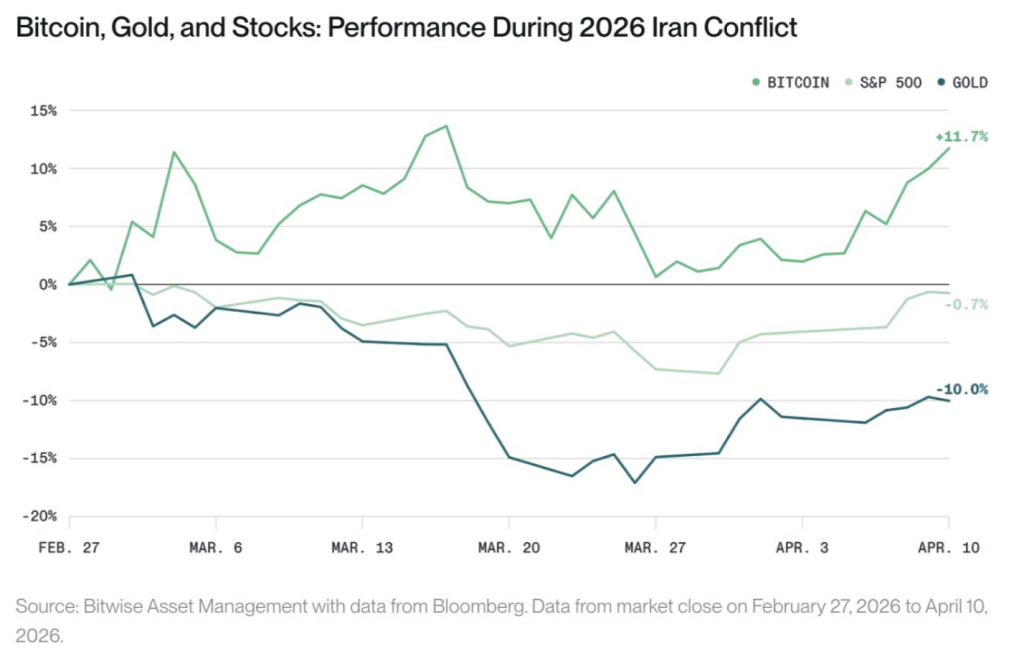
A $1 Million Price Target — And Possibly Higher
Hougan previously put a number on his store-of-value thesis: if Bitcoin captures 17% of that market over the next decade, each coin could be worth $1 million.
Based on his latest comments, that figure may need to be revised upward if Bitcoin begins functioning like a currency alongside its role as a savings vehicle.
At the time of writing, Bitcoin trades around $74,150, with a total market cap of roughly $1.4 trillion. Gold, by comparison, sits at $4,854 per ounce, with an estimated market cap exceeding $33 trillion.
Corporate treasuries have also been buying in. Data shows private and public companies collectively hold more than 1.5 million Bitcoin, valued at over $116 billion.
Merchant Adoption Remains A Work In Progress
Still, the currency side of the equation has ground to cover. A study by academic publisher Springer Nature found roughly 11,000 merchants worldwide currently accept Bitcoin as payment — a relatively modest number for an asset of its size.
Adoption has been strongest in countries where local currencies have collapsed. Citizens in Turkey and Venezuela, like those in Argentina, have turned to Bitcoin to protect savings against persistent inflation.
Whether Iran’s crypto toll proposal signals a turning point for Bitcoin as an international currency — or simply reflects one sanctioned nation finding a workaround — remains to be seen. What’s clear is that Bitwise believes the story is bigger than gold alone.
Featured image from Meta, chart from TradingView
